
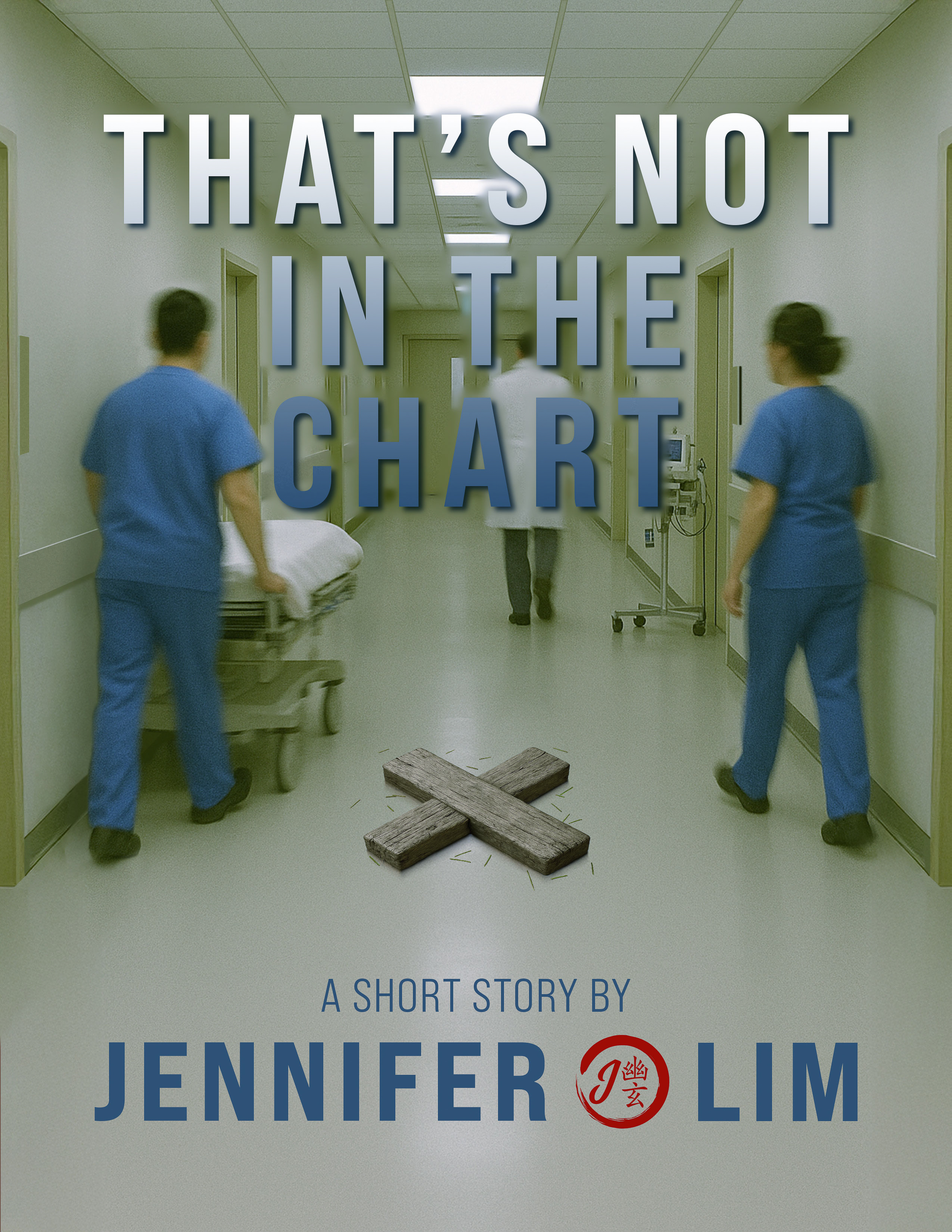
THAT'S NOTIN THECHART
Jennifer  Lim
Lim
A True ER Story About the Gifts That Never Make the Chart
© 2025 Jennifer J Lim
Before the doors split open, before the pine needles and paper stars, there was only the noise—monitors chirping, the antiseptic bite of alcohol in the air, the hum before the next alarm.
The ER pulsed like a wounded heart—Santa Clara Valley Medical Center's second shift in full storm. We were the County's last stop. The safety net. The battlefield. Always ready—though readiness was its own kind of fiction. You could know every code, every drill, but never predict the night.
Two hundred and fifty emergencies a day. All documented, all tracked. But on this night? A full moon. A Friday. Second shift—the unholy trifecta. Some things don't fit the metrics. The world doesn't knock—it just comes crashing through the doors, unannounced.
I was the charge nurse that night—tasked with holding the line when the world cracked open. Every bed was taken. A girl screamed at her mother over the steady beep of monitors. A man clutched his chest. A prisoner cursed over the radio—transport inbound, combative. Outside, a chopper touched down with a burn victim barely breathing.
In the eye of this storm, one figure remained steady. At triage sat Paula Elmore—veteran nurse, calm in the chaos, always a beat ahead. She moved with quiet precision, hands steady even as the night unraveled around her.
Her badge was always a little crooked. Just enough to notice. No one mentioned it. Maybe it was a quirk. Or maybe it was her way of reminding herself—and us—that perfection wasn't the point. Some things matter more than compliance.
The doors whooshed open, slicing the noise. For a moment, even the monitors seemed to pause.
Paul stood there, small against the night. But size, we'd learned, had nothing to do with presence. He was a quiet, dignified man who moved through the margins, familiar to our halls in ways that never made the paperwork.
Sometimes Paul came for a sandwich. Sometimes just for the lights, the warmth, the safety. But this time, he brought something—wrapped in crinkled newspaper.
"Paula," he rasped, "brought you something." She unwrapped it gently: a small heartfelt gift, bright with intention—the kind that shifts a room without asking permission.
The ER exhaled. Even the beeping seemed softer. Trauma crews laughed—the good kind, the kind that lets you breathe again. Moments like this don't land in charts. But they land somewhere else.
Two days later, Paul returned—dragging a full flower bush behind him, roots dangling like a promise. "For you, Paula." No one asked from where. It didn't matter.
Stories like Paul's rarely show up on vitals. But they change the room.
And then came the tree.
A full ten-foot Christmas tree, scraped across the linoleum, leaving a trail of needles and awe. The ER froze. Then it erupted—laughter, disbelief, something like wonder. Pine cut through antiseptic. Joy checked in without triage.
No fire code could explain what happened next. No policy could contain it. Families joined in. Cotton balls became snowmen. Gauze drifted like snow. Even the fluorescent lights seemed kinder.
And then—just as quickly—it was gone. Facilities. Fire hazard. A paper sign on a door. The corner empty except for needles scattered like memories.
"We can get another tree," I told them. "Fire-safe. Approved. Code compliant." The silence said everything.
Paula's voice cut through: "But it's not Paul's gift."
That was the truth beneath all of it. The thing we couldn't chart. The thing that stays long after the monitors quiet.
When I think of Christmas, I don't think of perfect. I think of Paul. I think of Paula. And I think of a tree no one could replace.
In memory of Paula Elmore — colleague, mentor, friend.
You taught us what courage looks like in scrubs.